Belonging and Family Ties
The Painted BirdBelonging and Family Ties in The Painted Bird are neither a simple recovery of what the war took nor a secure refuge from its violence. The boy’s reunion with his birth parents restores a family bond, but it also separates him from the Red Army friends who have become his chosen household. His return to kinship is therefore marked by recognition and obligation as much as affection: he is found, yet remains uncertain where he belongs.
Separation and the Search for a Place
The boy’s family ties have been broken by war and prolonged separation. When the fighting ends, Gavrila explains that lost children must be taken to special centers while officials determine whether their parents are alive. The procedure makes family reunion possible, but also requires the boy to leave the people and routines that have sustained him. It takes him several days to accept that he must part from Gavrila, Mitka, and the other soldiers. He holds back tears as Gavrila explains the decision; Gavrila, too, is uneasy, and the boy understands that he and Mitka have considered his future together.
Gavrila offers a conditional promise: if no relatives claim the boy within three months after the war, he will take responsibility for him and send him to a school where he can learn to speak again. The offer gives the boy a possible future within the regiment’s circle, though it depends on the absence of a family elsewhere. In the meantime, Gavrila tells him to be brave, remember what he has learned, and read Pravda each day. Care here is practical as well as emotional: it includes teaching, a plan for education, and an attempt to prepare him for life beyond the regiment.
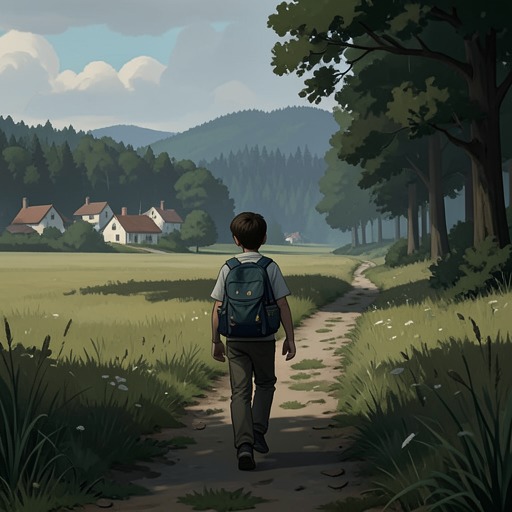
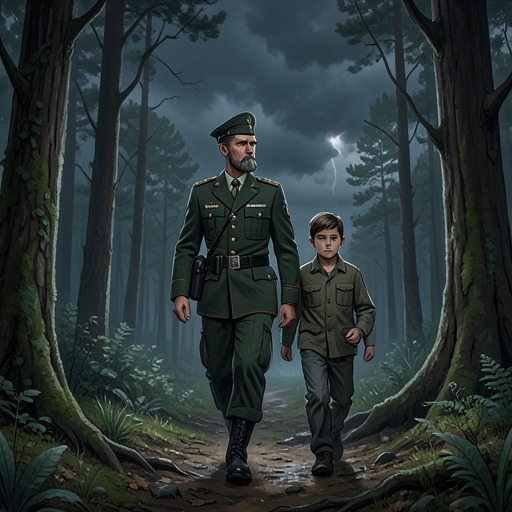
Before the boy leaves, the soldiers give him gifts and Gavrila and Mitka provide books. A regimental tailor has made him a Soviet Army uniform, and a small wooden pistol in its pocket bears pictures of Joseph Stalin and Lenin. These objects make the parting tangible: he carries with him tokens of the community he is leaving. Gavrila also assembles a personal file recording the boy’s name, former residence, and what he can recall about his parents, hometown, relatives, and friends. His route to family thus runs through both memory and paperwork. He travels with sergeant Yury to a center for lost children in the industrial city where he lived before the war.
Recognition and the Claims of Kinship
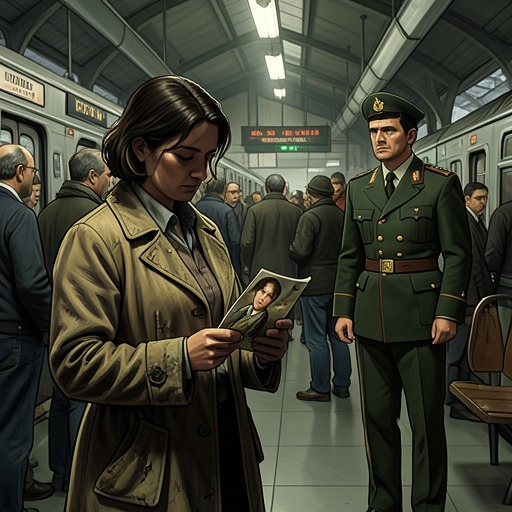
At the center, a member of the Social Commission brings a man and a woman into the room. The boy finds them familiar and notices their resemblance to the parents he has been separated from. Recognition does not bring immediate ease: he tries to keep an indifferent expression and wonders whether to admit that he knows them. His uniform’s star is on his chest as he scrutinizes their faces, making the military identity he has acquired part of the scene of reunion.
The woman bends toward him in tears, while the man, visibly overcome, asks him to unbutton his uniform so they can check for a birthmark on his chest. The boy knows it is there and hesitates, understanding that showing it will settle the question of who he is. He eventually opens his uniform, partly because he feels sorry for the crying woman. When the mark confirms their relationship, his parents embrace and kiss him. The moment establishes kinship as a fact, but it does not dissolve his ambivalence.
The boy understands that, at twelve, he is not yet grown and that his parents have a right to take him home. That recognition competes with his own sense of choice. He thinks he could run away and take a crowded train, and he knows that returning to his parents means giving up dreams of remaining in Gavrila and Mitka’s world. He imagines a future there as an inventor of devices that could change people’s color, in a place where the present already seems to contain the future. Family reunification is thus experienced as a real change of allegiance, not simply as the recovery of an unquestioned home.
Two Households, and the Unease of Return
The parents appear frail rather than threatening to him. His father adjusts his spectacles and supports his crying wife; the boy sees them as people who seem unwell, not as figures who would beat him. Yet being loved and protected feels constricting. He finds it difficult to imagine becoming someone’s real son, receiving affection and care, and obeying because these people are his parents rather than because they have the power to hurt him. His hesitation turns on the difference between authority enforced by force and a family claim he recognizes but has not yet learned how to inhabit.
The boy’s reflection on Lekh’s painted bird gives this conflict a metaphorical shape. He feels an unknown force pulling him toward his own kind, even while his thoughts keep turning toward escape. The image does not make reunion uncomplicated; it shows that belonging may exert a pull without making a person feel immediately free or at home. His mother reassures him that he will be happy and able to do what he wants, and says his parents will make him a new uniform matching the one he wears. The promise offers continuity with the identity he has formed, but it cannot preserve the regiment itself.
His parents take him from the orphanage to an apartment they have borrowed with difficulty after learning that a boy matching their son’s description is at the local center. There he discovers that they have adopted a four-year-old boy. The child’s parents and older sister were killed, and an old nurse had handed him to the boy’s father during the family’s wanderings in the third year of the war. His birth parents love the adopted child, whose presence makes the household a place shaped by more than one wartime loss. Rather than settling the boy’s doubts, this new tie deepens them: he wonders whether he would be better off alone, waiting for Gavrila to adopt him.
The apartment’s crowded conditions make the distance between abstract family reunion and daily life concrete. It consists of one room and a kitchen, with a washroom on the stairs, and the family has little space to move without getting in one another’s way. His father has a heart condition and takes pills when upset; his mother rises at dawn to wait in food queues before returning to cook and clean. These circumstances do not negate the parents’ care, but they place the boy in an intimate household with needs, vulnerabilities, and routines unlike the mobile life he has imagined.
Chosen Bonds and an Unfinished Belonging
The boy’s attachment to Gavrila and Mitka continues after he leaves the regiment. He often slips away to meet the Silent One, maintaining a connection to the orphanage, and visits it in the hope of finding a letter from Gavrila or Mitka. When the Silent One fails to appear, the boy later learns that he has been transferred to another city. The disappearance narrows his access to the community he has left. His parents’ claim is present in daily life, but the friendships and mentorships he associates with the regiment remain powerful measures of where he might rather be.
The end of the war does not promptly resolve that separation. The boy reads the newspapers closely and learns that not all armies will return home; Germany is to be occupied, and Gavrila and Mitka may be away for years. The absence of letters from them leaves his hoped-for future suspended. He is no longer simply waiting for the fighting to end: he is living with his parents while measuring his present against a possible return to his former companions.
The narrative therefore treats belonging as something made through several competing ties. Birth establishes the family relationship, and the center’s procedure confirms it; the regiment offers care, education, shared purpose, and the promise of continued protection; the orphanage and the Silent One preserve another connection to the boy’s unsettled past. None of these bonds cancels the others. His return to his parents is an outcome, but not a completed emotional reconciliation. The boy goes with them while still imagining a life elsewhere, making family reunion both a restoration and a new separation.